Upselling
10 Hotel Upselling Examples That Add Value to the Guest Experience
· By Nokrach Gerard Trevor
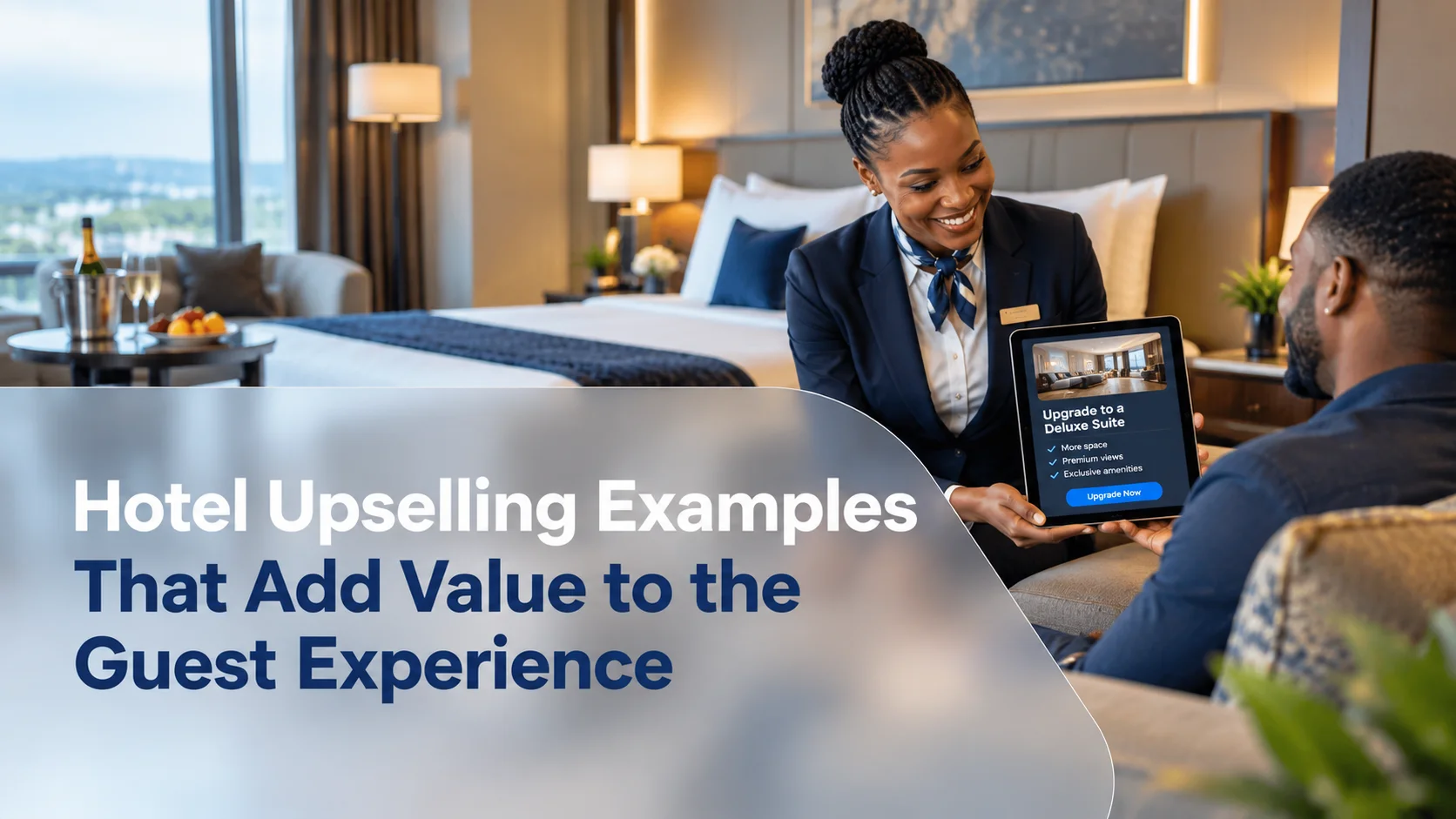
Hotel upselling can help a property generate additional revenue from guests who have already booked or checked in. But a successful offer is not simply an invitation to spend more. It gives a guest the opportunity to improve their stay through a relevant service, a useful upgrade, or an added convenience.
For example, a guest arriving early might appreciate an available early check-in option. A couple celebrating a special occasion might welcome a suitable dining package, while a business traveller could value a reliable airport transfer.
The key is to match the offer to the guest's needs, the timing of the message, the price, and the hotel's ability to deliver the service.
In this guide, we explore ten hotel upselling examples that properties can adapt to their own services, guests, and operating conditions. Not every hotel offers every service, so treat these examples as a starting point rather than a standard list of amenities every property should promote.
1. Room upgrades
Who it suits: Guests who may value additional space, a better view, a higher room category, or extra in-room amenities.
Best moment: Before arrival, during check-in, or when a suitable upgrade becomes available.
What to disclose: The room category, additional price, key differences, and whether the quoted amount covers the full stay or a specific night.
Operational check: Confirm that the upgraded room is available and ready for the guest's dates.
A room upgrade is one of the most recognisable hotel upselling examples. Instead of offering a completely different product, the hotel invites a guest to pay for a higher room category that better suits their preferences.
For instance, a guest booked into a standard room might be offered a larger room with a sitting area. A leisure traveller could prefer a room with a better view, while a guest staying several nights might appreciate additional space.
The offer should explain the practical benefit rather than relying on descriptions such as “exclusive” or “premium.” Guests need to understand what they receive for the extra cost.
Example offer: “Would you like to upgrade to our larger room category for an additional UGX [amount] per night? It offers more space and a separate sitting area. Availability is subject to confirmation.”
The price, room features, and availability must be accurate before the offer is sent.
2. Early check-in or late check-out
Who it suits: Guests arriving before the standard check-in time or those who need more time before departure.
Best moment: Before arrival, when the guest shares their travel schedule, or before departure.
What to disclose: The additional fee, permitted arrival or departure time, and any conditions.
Operational check: Coordinate with housekeeping, reception, and room availability.
Early check-in and late check-out can provide convenience while helping a hotel earn revenue from an otherwise underused service opportunity. However, the hotel must not promise a room or departure extension that its operations cannot accommodate.
An arriving guest with an early flight or a departing guest with an evening journey may find the extra time particularly useful. Other guests may prefer to use luggage storage or another alternative if the paid option is unavailable.
Example offer: “Your room is scheduled to be available from [standard time]. Early check-in from [earlier time] may be available for an additional UGX [amount], subject to room readiness. Would you like us to check availability?”
The same approach applies to late check-out. Explain the benefit, confirm the conditions, and give the guest a genuine choice.
3. Breakfast or dining packages
Who it suits: Guests whose booking does not already include breakfast, or those likely to value an additional meal.
Best moment: Before arrival, during check-in, or when the guest asks about dining options.
What to disclose: The menu or package, price per person, service times, and what is included.
Operational check: Confirm restaurant capacity, meal availability, and any dietary requirements the hotel can accommodate.
A guest may have booked a room-only rate without realising that breakfast is available at the property. A clear breakfast offer can make the service easier to discover and purchase.
Hotels can also offer meal packages where appropriate, such as a set lunch or dinner menu. The offer should reflect the property's actual dining options and the guest's circumstances.
Example offer: “Would you like to add breakfast to your stay for UGX [amount] per person? Breakfast is served from [start time] to [end time] at [restaurant/location].”
The hotel should avoid offering breakfast to guests whose rate already includes it unless the offer clearly relates to an additional service. Restaurant capacity and the price of the package should also be confirmed.
4. Spa and wellness bookings
Who it suits: Guests interested in relaxation, wellness, or a convenient way to use their free time.
Best moment: Before arrival, during a leisure stay, or when the guest asks about wellness facilities.
What to disclose: Treatment type, duration, price, available appointment times, and booking conditions.
Operational check: Confirm therapist availability, treatment-room capacity, and the actual services offered by the property.
If a hotel has a spa or wellness facility, guests may appreciate being able to reserve a treatment without having to search for information themselves.
An offer becomes more useful when it includes specific details. “Book a spa treatment” provides little information, while an offer describing the service, duration, price, and available times helps the guest decide.
Example offer: “We have a [treatment name] appointment available at [time] on [date]. The session lasts [duration] and costs UGX [amount]. Would you like us to reserve it for you?”
The hotel should send this type of offer only when the service and appointment are genuinely available. If the property has no spa or wellness service, this example is not applicable.
5. Airport transfers
Who it suits: Guests who need transport to or from the airport and prefer to arrange it in advance.
Best moment: After booking, before arrival, or when the guest shares flight details or asks about transport.
What to disclose: Total price, pickup location, journey details, vehicle type where relevant, and cancellation or waiting-time conditions.
Operational check: Confirm the vehicle, driver, pickup time, and flight or arrival details.
Airport transfers can simplify a guest's arrival, particularly for travellers unfamiliar with the destination. They may also reduce the uncertainty of arranging transport after landing.
The offer should make the convenience clear without implying that the transfer is automatically included in the room rate.
Example offer: “Would you like us to arrange an airport transfer for your arrival on [date]? The total price is UGX [amount] for [number] passengers. If you are interested, please share your flight arrival time so we can confirm the pickup details.”
Where a hotel works with a third-party transport provider, it should explain the arrangement accurately and confirm the partner's availability before accepting the booking.
6. Local tours and experiences
Who it suits: Leisure travellers, first-time visitors, and guests who have time available to explore the destination.
Best moment: Before arrival or early in the stay, when there is enough time to arrange the experience.
What to disclose: The activity, duration, price, inclusions, transport arrangements, and cancellation terms.
Operational check: Confirm availability with the hotel team or trusted partner and allow enough time for booking and coordination.
A hotel may be able to help guests discover local attractions, guided tours, cultural activities, or outdoor experiences. These services can make a stay more convenient while creating an additional revenue opportunity for the hotel or its partners.
The most useful offer gives the guest enough information to judge whether the experience fits their schedule and interests. A tour that takes most of the day may not suit someone staying for only one night.
Example offer: “Interested in exploring [destination or attraction]? We can help arrange a [duration] guided experience on [date], subject to availability. The price is UGX [amount] per person and includes [inclusions]. Would you like more details?”
Use reliable providers, verify the details, and avoid making assumptions about a guest's interests based on sensitive or personal information.
7. Premium dining or special-occasion options
Who it suits: Guests who express an interest in a special meal, celebration, or more personalised dining experience.
Best moment: When a guest asks about celebrations or dining, or when they voluntarily share relevant plans.
What to disclose: Menu, price, inclusions, reservation time, and any special arrangements.
Operational check: Confirm restaurant availability, kitchen capacity, and whether requested arrangements can be delivered.
Where a hotel offers suitable dining services, it may present options such as a set menu, a private dining arrangement, or a celebration package.
Relevance matters. A guest who has asked about a birthday arrangement has provided a clear reason to discuss a suitable option. A guest who has shared no such information should not receive a message that assumes they are celebrating something.
Example offer: “If you are planning a special dinner during your stay, our [package name] includes [details] for UGX [amount] per [person/couple]. We can check available reservation times if you are interested.”
The aim is to make a useful option visible, not to pressure guests into purchasing something they did not request.
8. Meeting or event add-ons
Who it suits: Business travellers, meeting organisers, conference delegates, and guests who have booked an event space.
Best moment: During event planning, after a meeting-room reservation, or when the organiser confirms their requirements.
What to disclose: Package contents, equipment, catering quantities, price, setup times, and any additional charges.
Operational check: Confirm room capacity, equipment, catering availability, staffing, and event schedules.
Hotels with meeting or event facilities may have opportunities to offer services beyond the room hire. Depending on what the property actually provides, these could include refreshments, lunch packages, audiovisual equipment, printing, or extended room use.
The offer should respond to a real event requirement. An organiser who needs a projector or refreshments may appreciate having these options presented together instead of arranging each item separately.
Example offer: “For your meeting on [date], we can provide a refreshment package for [number] attendees at UGX [amount] per person. It includes [items]. Would you like us to check availability?”
Confirm quantities and delivery arrangements before accepting the order. Do not promote equipment or facilities the hotel cannot provide.
9. Family or convenience packages
Who it suits: Guests who have indicated a need for family-friendly arrangements or practical conveniences during their stay.
Best moment: During booking follow-up or before arrival, once the relevant requirement is known.
What to disclose: Included services, age or occupancy restrictions where applicable, total price, and any booking conditions.
Operational check: Confirm that the requested items or services are available and that the room and staffing arrangements are suitable.
Some hotels offer services that make travelling with children or managing a longer stay more convenient. Depending on the property, these might include an extra bed, a suitable meal package, laundry, or a family activity.
These are not universal hotel services. The offer must reflect the property's actual catalogue and policies.
Example offer: “If you need an extra bed for your stay, we can check whether one is available for your room. The additional charge is UGX [amount] per night, subject to occupancy and room conditions.”
Present options based on information the guest has voluntarily provided. Avoid assuming that a guest is travelling with children or needs a particular service simply because of their name, booking type, or appearance.
10. Extended-stay or return-visit offers
Who it suits: Guests who may benefit from staying longer, or previous guests who have a relevant reason to return.
Best moment: During the stay when an extension is possible, or after departure as part of a suitable return-visit campaign.
What to disclose: Eligible dates, room category, total price, restrictions, and how to confirm the extension or make a new booking.
Operational check: Confirm room inventory, rate approval, offer validity, and the booking process.
An existing guest may need to extend a business trip or decide to stay an extra night. If the hotel has suitable availability and an approved rate, it can present the option clearly.
Similarly, a hotel may invite previous guests to return with a seasonal package or another offer that fits its commercial plans. The terms should be clear, and any discount should be based on an approved pricing decision.
Example offer: “Would you like to extend your stay by one night, checking out on [new date]? We can check availability and confirm the additional cost before you decide.”
For return-visit offers, explain the booking dates, eligibility, and any restrictions. Do not imply that an extension or promotional rate is guaranteed until it has been confirmed.
How to choose the right hotel upselling offer
The examples above are most useful when a hotel adapts them to its guest profile, service catalogue, pricing, and operating capacity. Start with services that already exist and can be delivered reliably, rather than creating offers simply to fill a marketing calendar.
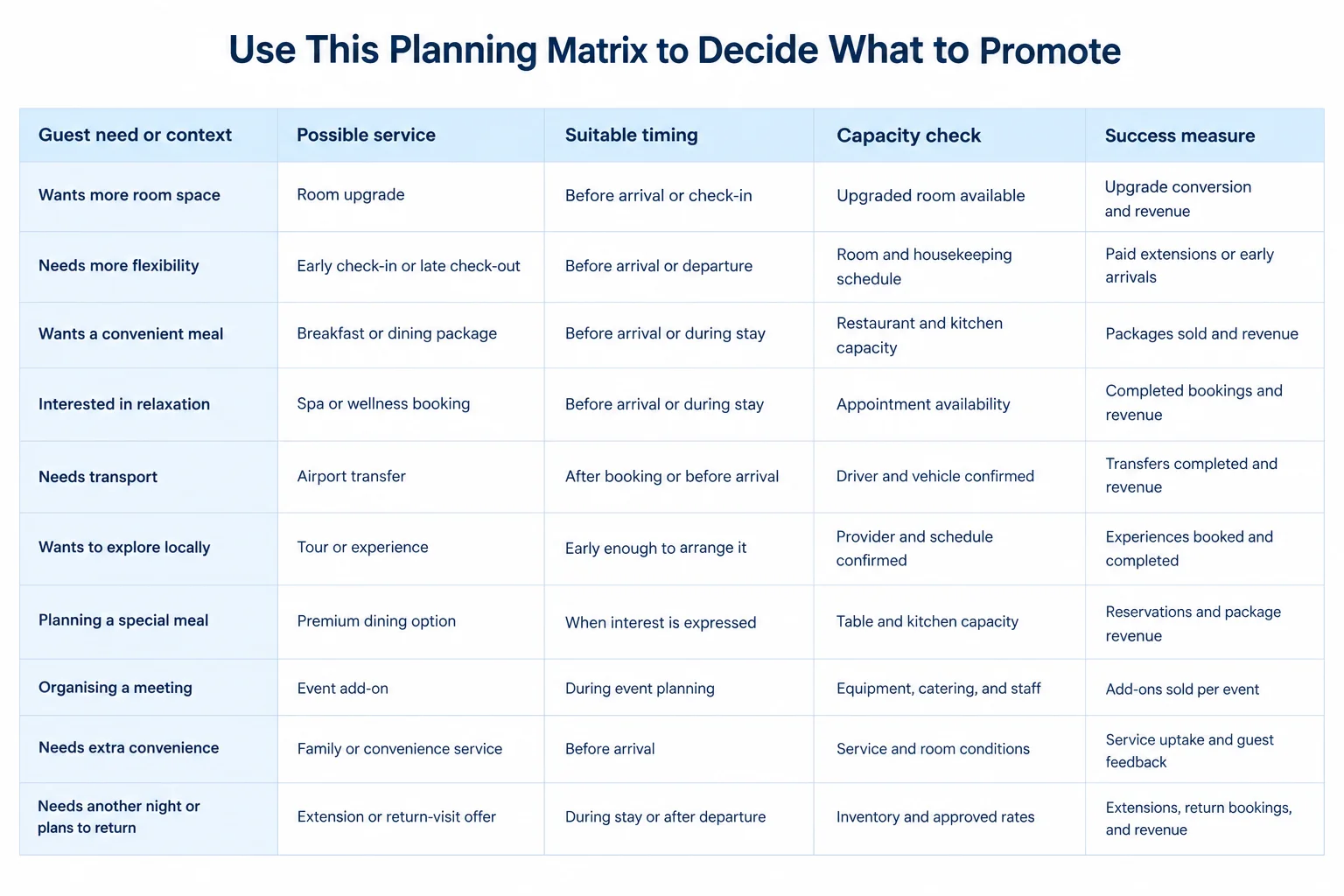
Measure more than the number of offers sent
A hotel should not judge its upselling activity only by how many messages it sends. Track how many guests engage, how many offers convert, how much revenue is generated, and whether accepted services are delivered correctly.
It is also useful to monitor guest complaints, cancellations, fulfilment failures, and the number of offers declined. These indicators help the hotel identify whether an offer is relevant and operationally sound.
Where possible, calculate revenue after discounts, commissions, and delivery costs rather than relying solely on gross sales. That gives management a more useful view of the commercial value created.
For a step-by-step foundation, read our hotel upselling guide for managers, which explains the principles behind building a practical upselling process.
Turn hotel services into relevant guest offers
The best hotel upselling strategy is not about promoting every service to every guest. It is about making the right service visible when it can genuinely improve the guest's stay—and ensuring the hotel can deliver what it offers.
Start by listing your existing services, their prices, availability rules, and the guest needs they can address. Choose a small number of offers to test, measure guest responses and completed sales, and improve the process based on what you learn.
If your hotel wants to manage guest offers more systematically, learn more about HOSCover's hotel upselling solution. HOSCover is designed to help hotels engage existing guests with relevant offers, connect guest responses to operational follow-up, and track the resulting commercial activity.