Upselling
When Should Hotels Offer Room Upgrades and Additional Services?
· By Nokrach Gerard Trevor

A room upgrade can be attractive to a guest, but the timing of the offer can determine whether it is useful or simply ignored. The same applies to breakfast packages, airport transfers, spa appointments, dining reservations, and other hotel add-on services.
A guest may appreciate an airport transfer offer before arrival but have little use for it after reaching the hotel. A room upgrade may be relevant before check-in, while a late check-out offer makes more sense closer to departure.
So, when should hotels upsell guests? The best time is when an offer is relevant to the guest's circumstances, the service is available, the price and conditions are clear, and the hotel can fulfil the request.
This requires more than choosing a convenient time to send a message. Hotel teams need to understand the guest journey, identify appropriate opportunities, and coordinate offers with operational capacity.
This guide explains how to approach timing at each stage of a guest's stay.
Before booking versus after booking
Hotels should distinguish between encouraging someone to make a reservation and offering additional services to someone who has already booked.
These activities may support the same commercial goals, but they serve different purposes.
Before booking, the hotel is trying to attract a reservation. Pricing, room packages, promotions, and availability influence the guest's decision to book. This is primarily part of the hotel's sales and distribution strategy.
After booking, the hotel has an existing guest relationship and can consider relevant additional services. These might include a room upgrade, breakfast, airport transfer, or an experience during the stay.
For example, someone comparing hotels may respond to a room package that includes breakfast. A guest who has already reserved a room without breakfast may instead appreciate an opportunity to add it before arrival.
The distinction matters because post-booking offers should complement the original reservation rather than create confusion about what the guest has already purchased.
Hotels should also check the booking details before making an offer. A guest whose rate already includes breakfast should not receive an invitation to purchase the same inclusion again.
Pre-arrival opportunities
The period between reservation and arrival gives hotels an opportunity to help guests prepare for their stay.
Guests may still be arranging transport, deciding where to dine, considering room preferences, or planning activities. This makes pre-arrival communication suitable for services that benefit from advance planning.
Potential offers include:
Room upgrades: Present a higher room category when inventory and pricing allow.
Airport transfers: Help guests arrange transport before travelling.
Dining reservations: Share restaurant options and available reservation times.
Local experiences: Present relevant activities that require advance booking.
Breakfast packages: Offer breakfast where it is not already included in the booking.
For example, a guest arriving from another city may appreciate knowing that the hotel can arrange an airport transfer. A guest planning a longer leisure stay might also welcome information about available dining or wellness services.
The offer should provide enough information for the guest to make a decision. Include the service description, price, availability conditions, and a clear way to respond.
Example message:
"Thank you for booking with us. We can help arrange an airport transfer for your arrival on [date]. The service costs UGX [amount] for [number] passengers, subject to confirmation. Would you like us to check availability?"
The hotel should confirm the actual arrangement before promising a pickup.
Pre-arrival offers should also be selective. Sending every available service to every guest can make communication feel like advertising rather than useful preparation.
At arrival and check-in
Check-in can be a suitable moment to discuss additional services, but it is also a busy operational period.
Guests may be tired after travelling, waiting to receive their room, or trying to complete the arrival process quickly. Front-office employees may be handling several requests at once.
For this reason, hotels should avoid treating check-in as an automatic opportunity to promote multiple offers.
A relevant offer may be appropriate when:
A suitable room upgrade is available and ready.
The guest asks about additional services.
The guest needs information about dining or transport.
An operationally approved early check-in option is available.
The offer can be explained without delaying the check-in process.
For example, if a guest asks whether a larger room is available, reception can check the inventory and explain the additional cost.
Example message:
"We have a larger room category available for your stay. It offers [specific benefit] at an additional UGX [amount] per night. Would you like to consider this option?"
The front-office team should confirm the room category, availability, and price before presenting the offer.
A useful rule is to make the arrival experience the priority. If the guest is dealing with a problem or the reception area is busy, promotional offers can wait.
During the stay
Once guests have settled in, their needs may become clearer. They may ask about restaurant opening times, enquire about local attractions, or decide to use services they did not plan for before arrival.
This creates opportunities for relevant in-stay offers.
For example:
A guest asking about dinner options may appreciate information about an available dining package.
A guest enquiring about relaxation services may be interested in a spa appointment.
A guest planning an activity may want help arranging a local experience.
A guest who needs laundry services may appreciate clear information about the available options and charges.
The most useful offers are connected to an actual service need, enquiry, or relevant part of the stay.
Hotels should avoid sending messages simply because a certain number of hours have passed since check-in. Message timing should reflect the service, the guest's context, and whether the hotel can deliver it.
Example message:
"We hope you are enjoying your stay. If you would like to dine at [restaurant], we currently have reservations available at [times]. You can view the menu here: [link]."
This is more useful than a generic message asking the guest to purchase additional services without explaining what is available.
Before departure or after checkout
The period before departure can create another set of relevant opportunities.
A guest with a late flight may appreciate a late check-out option, provided the hotel can accommodate it. Someone leaving early may need transport arrangements. Other guests may simply want information about the checkout process.
Possible offers and communications include:
Late check-out: Present an additional departure-time option when room availability and housekeeping schedules permit.
Departure transport: Share transfer information where the guest needs assistance arranging a journey.
Guest feedback: Invite the guest to share their experience after the stay.
Return-visit campaigns: Where appropriate, communicate an approved offer for a future booking after departure.
Not every departure communication needs to sell something. Sometimes the most useful interaction is a clear reminder of checkout arrangements or a request for feedback.
Return-visit campaigns should also be handled separately from immediate in-stay upselling. They need an appropriate audience, valid offer terms, and respect for the guest's communication preferences.
Signals to consider before sending an offer
Choosing the best time to upsell hotel guests requires understanding more than the calendar.
Hotel teams should consider several signals before deciding whether to communicate an offer.
1. Stay dates and booking details
Arrival dates, departure dates, length of stay, and room category can help determine which services may be relevant.
For example, an offer for an additional night should be considered only when the guest's stay dates and room availability make an extension possible.
2. Available services
The hotel needs accurate information about which services are currently offered, their prices, operating hours, and booking conditions.
An offer based on outdated information can create disappointment and additional work for staff.
3. Guest requests and expressed preferences
A guest who asks about transport has provided a clear reason to share relevant transport information. A guest who requests dining recommendations may appreciate details about the hotel's restaurant.
Use information that guests have voluntarily provided or that is appropriately available for the purpose. Avoid making sensitive assumptions about a guest's interests, circumstances, or personal life.
4. Current operational capacity
Availability can change quickly. Room inventory, restaurant capacity, appointment slots, transport arrangements, and staffing levels should be checked before an offer is confirmed.
An offer should not be sent simply because a service exists in the hotel's catalogue. The hotel must be able to deliver it under the stated conditions.
5. Previous communication and responses
Hotels should consider whether the guest has already received an offer, accepted it, declined it, or asked not to receive further messages.
Repeating an offer that a guest has already declined can make communication feel intrusive.
Frequency, consent, and guest comfort
Even a relevant offer can become unwelcome when it is repeated too frequently.
Hotels should establish communication rules that protect the guest experience while allowing staff to present useful services.
Consider the following principles:
Set contact limits. Decide how frequently promotional offers can be sent during a stay. The appropriate limit will depend on the hotel's communication channels, guest journey, and service types.
Respect opt-outs. If a guest declines further promotional communication or opts out, follow the applicable communication and privacy requirements.
Separate service updates from promotions. A necessary update about a confirmed transfer is different from an unsolicited offer for another service. Keep the purpose of each message clear.
Avoid sensitive assumptions. Do not infer personal circumstances or interests without an appropriate basis. Use relevant booking information and guest requests responsibly.
Make the offer transparent. Explain the price, what is included, any restrictions, and how the guest can accept or decline.
Stop when the offer is no longer relevant. A guest who has checked out should not continue receiving messages intended for someone currently staying at the property.
The objective is to make communication helpful. Guests should feel that the hotel is making relevant services easier to access, not constantly trying to sell them something.
Hotel upselling timing matrix
The matrix below can help hotel managers connect each stage of the guest journey to suitable offers, eligibility checks, and responsible teams.
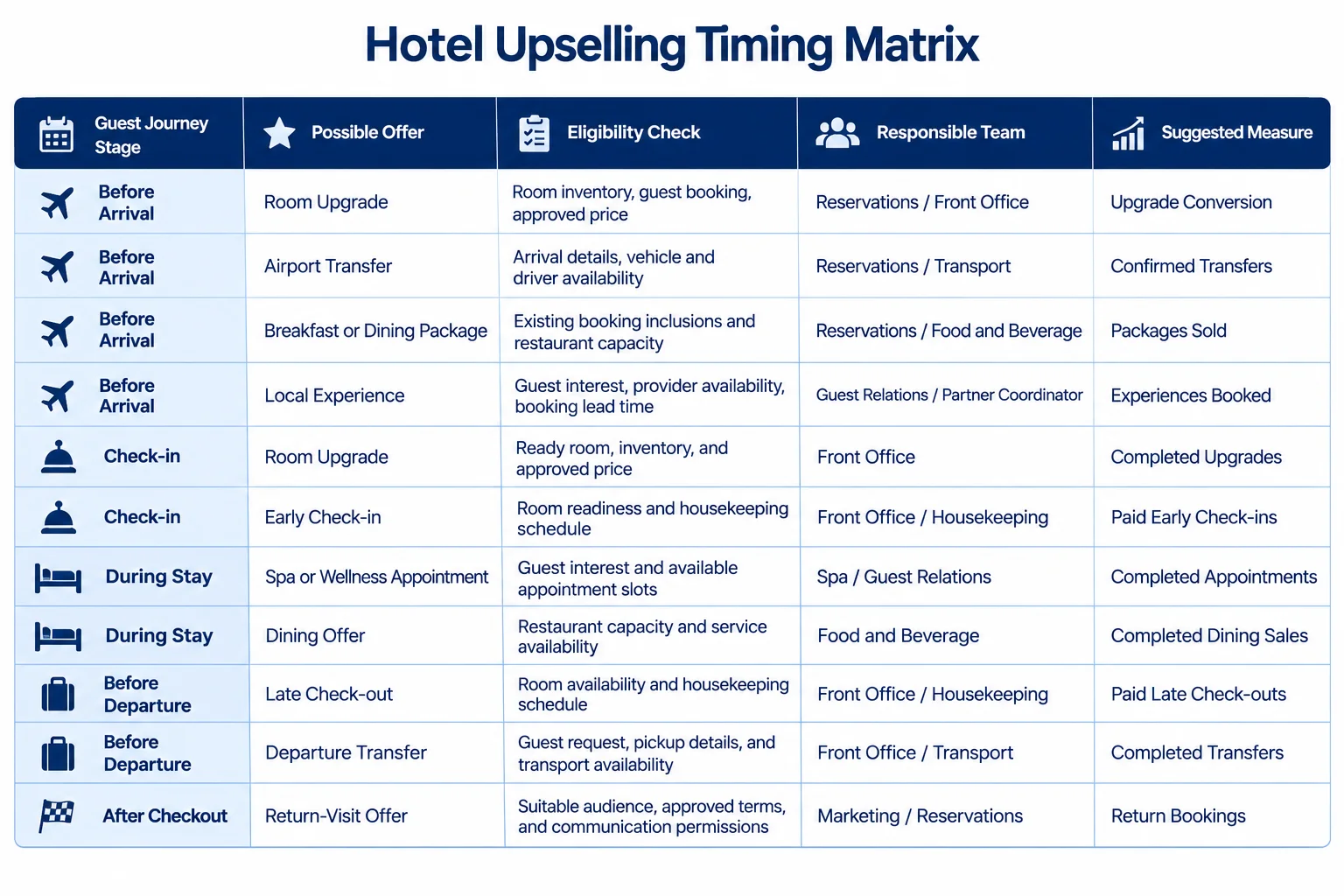
The matrix is a planning guide, not a requirement to send every offer at every stage. Hotels should adapt it to their own facilities, guest profile, staffing arrangements, and operating policies.
When should a hotel avoid sending an upselling offer?
There are situations where the best decision is not to send an offer.
Avoid sending an offer when:
The service is unavailable or its availability has not been confirmed.
The price or conditions are unclear.
The guest has already declined the offer or opted out of promotional messages.
The guest is dealing with an unresolved complaint or service problem.
The offer is unrelated to the guest's expressed needs or relevant booking context.
The hotel cannot fulfil the request within the promised timeframe.
The message would interrupt an important guest interaction or essential operational process.
The hotel does not have an appropriate basis to use the information behind the proposed targeting.
A missed sale is not always a problem. Protecting guest trust and avoiding an operational failure can be more valuable than sending an unsuitable offer.
FAQs about hotel upselling timing
When is the best time to offer a room upgrade?
A room upgrade can be offered before arrival or during check-in when the hotel has a suitable room available, an approved price, and enough time to confirm the change. The best moment depends on room inventory, the guest's booking, and the hotel's operational process.
How often should hotels message guests with offers?
There is no single frequency that works for every property. Hotels should establish reasonable contact limits based on the guest journey, communication preferences, and the relevance of each offer. Avoid repeatedly sending the same promotion or contacting guests who have opted out.
Should hotels send upselling offers before or after check-in?
Both stages can be appropriate. Before arrival is useful for services that require advance planning, such as transfers or dining reservations. Check-in can be suitable for available room upgrades or early check-in options. During the stay, offers should respond to relevant guest needs and service availability.
What information should a hotel check before sending an offer?
At a minimum, confirm the guest's relevant booking details, the service's availability, its price and conditions, the responsible fulfilment team, and the guest's communication preferences. This reduces the risk of presenting an offer the hotel cannot deliver.
Make guest-journey timing part of your upselling process
The best hotel upselling opportunities are not determined by message volume. They come from understanding what guests may need at different stages of their stay and presenting suitable services when the hotel can deliver them.
Start by mapping your guest journey. Identify the services that make sense before arrival, at check-in, during the stay, and before departure. Then assign responsibility for checking availability, communicating the offer, recording the response, and confirming fulfilment.
Use a guest-journey offer-planning worksheet to map each service to the right moment, eligibility conditions, responsible team, and success measure.
HOSCover is designed to help hotels engage existing guests with relevant offers and connect guest responses to operational follow-up. The aim is to make service opportunities easier to manage while keeping the guest experience and the hotel's ability to deliver at the centre of the process.